

Clinician Insights Series 5, Episode 1
We’re delighted to be back with Series 5 of Clinician Insights featuring our guest Cara Negri, BSME, CP and advocate for learning and development in the O&P field. Cara has over 30 years of experience as a prosthetist, and harnesses her interests in movement analysis, engineering, product development and instructional design to rehabilitate and empower people with disabilities. Needless to say, Cara shares some incredibly valuable perspectives in this series of Clinician Insights, starting with her introduction to O&P and her views on training and education in this first episode.
If you’ve not joined us before, this blog series is brought to you by Radii Devices, to open up conversations about digital technology and its role in clinical practice. We hope you enjoy this episode!
Now, let’s hear from Cara.
Jenny: Thank you so much for joining us today, Cara. Can you begin by telling us about the start of your career in prosthetics and orthotics?
Cara: It’s been a sweet journey. I got interested in the profession in 4th grade after reading a book about a person with an amputation. It was an inspiring story about overcoming adversity. I checked that book out so many times that the librarian gave it to me. I still have it, as a sweet reminder.
That book planted a seed. In high school, I worked at a prosthetics company and transitioned from being a technician to a prosthetist’s assistant, then completing my residency to become a certified practitioner. I also spent years at Össur in clinical education and research and development. My career has been incredibly rewarding, including opportunities to travel and learn from practitioners worldwide.
Jenny: That’s an awesome story, and I agree that we can learn from each other all the time to continue improving. Could you tell us about some of the most memorable experiences in your career?
Cara: Well, I always have fond memories of patient care, although I also have a few from my early years in the profession. As a young clinician, I remember walking into a facility where a seasoned practitioner questioned what I could teach him. I said, “Let’s work together to find a solution for your patient.” By the end of the day, he was grateful, which was a powerful moment for me. These experiences taught me the value of fresh perspectives and collaborative problem-solving.
Now, I work with many interns and residents, after almost 30 years in the profession myself. I love those moments of getting a fresh perspective from younger clinicians and students to this day. It reminds me of a quote by Grace Hopper: “The most dangerous phrase in our language is, ‘We’ve always done it this way.’” I try to embrace that mindset of learning from others while teaching and teaching is one of the most rewarding things that I do.
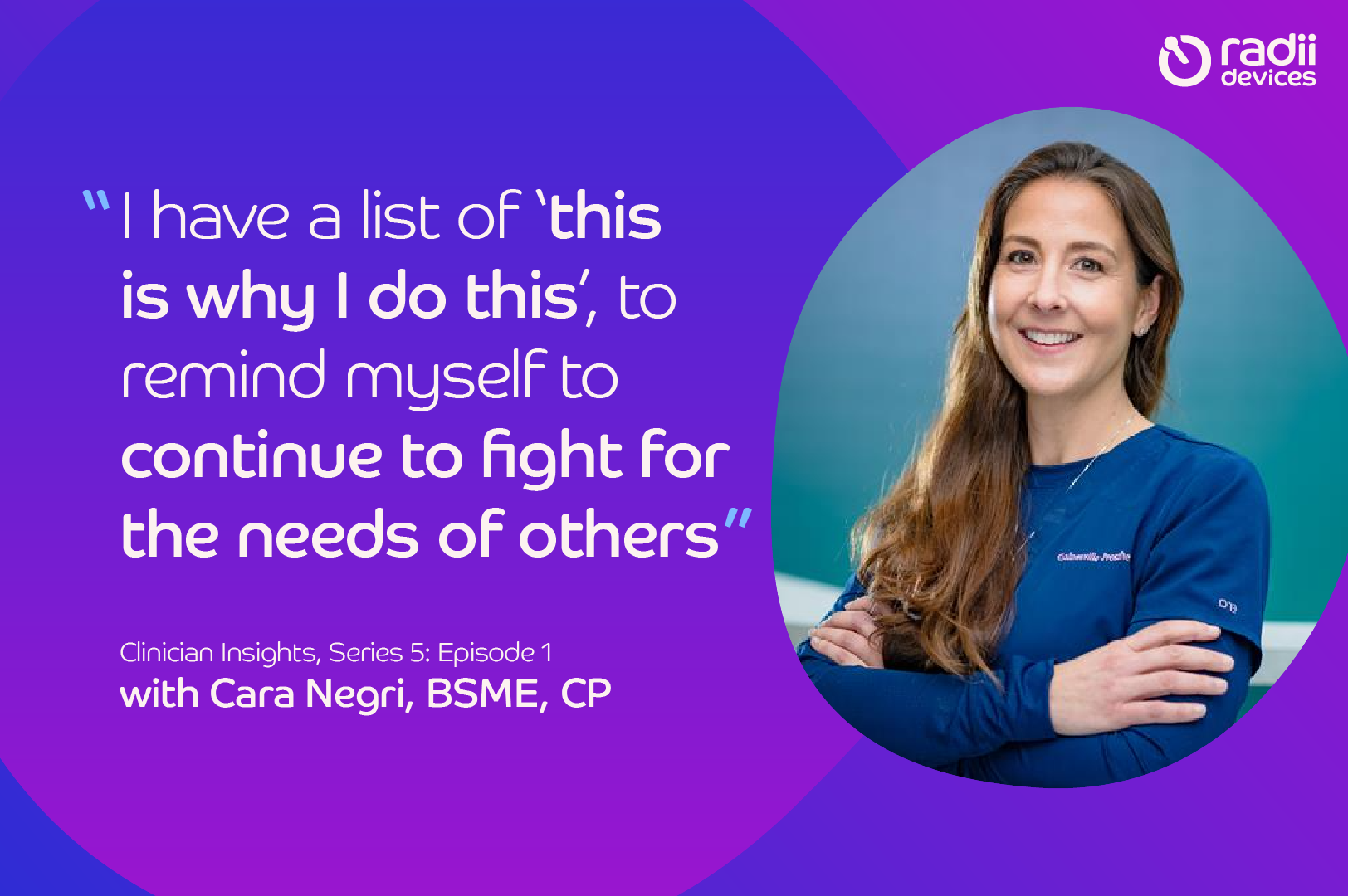
But as far as patients go, sometimes I can’t believe that I get to do this for a living. I’ve started to keep a diary of all of those memorable moments, so that when the hard times come, I have a list of ‘this is why I do this’, to remind myself to continue to fight for the needs of others.
Jenny: Thank you, Cara, that’s really insightful. It’d be great to talk more about clinical training and education in regards to digital technology, too.
Cara: As prosthetists, many of us believe in having a “special sauce” for modifications, but I actually don’t agree. I think that what makes me special as a prosthetist is that I persevere and don’t give up. However, I value evidence-based approaches that lead to more effective results for patients. At the end of the day, our demand is increasing, and we’ve got to be able to make people comfortable and active quicker than we’ve had to in the past.
Continuous learning is essential. For example, I took an Additive Manufacturing course at MIT to gain perspectives outside of O&P. Learning from fields like Aerospace Engineering helps us innovate within our profession. I encourage residents to explore both traditional and CAD-based methods, ensuring they gain well-rounded skills. It’s crucial to step out of comfort zones to grow.
Jenny: Thanks Cara, we’ll cover digital technology and industry developments more in the next episode. To close, can I ask what advice would you give to your younger self starting out in O&P?
Cara: I’d tell myself to ask for help more often. Early in my career, I felt like I needed to know everything, but seeking support doesn’t make you a bad practitioner—it makes you better. I encourage my residents to embrace discomfort because that’s where real learning happens.
I’d also remind myself about the importance of self-care. While it’s tempting to give endlessly, you can’t support others if you’re not taking care of your own mental and physical health. Younger generations are better at maintaining this balance, and it’s something we all need to prioritize.
This profession is incredibly rewarding because you’re constantly solving problems and coming up with new ideas. That’s what keeps it exciting for me.
Thanks Cara, we look forward to the next installment!
We hope that through following Clinicians Insights, you feel part of an ongoing conversation that furthers understanding of digital technology and research, supporting O&P practitioners who provide our patients with the best comfort, fit and socket fitting experience.